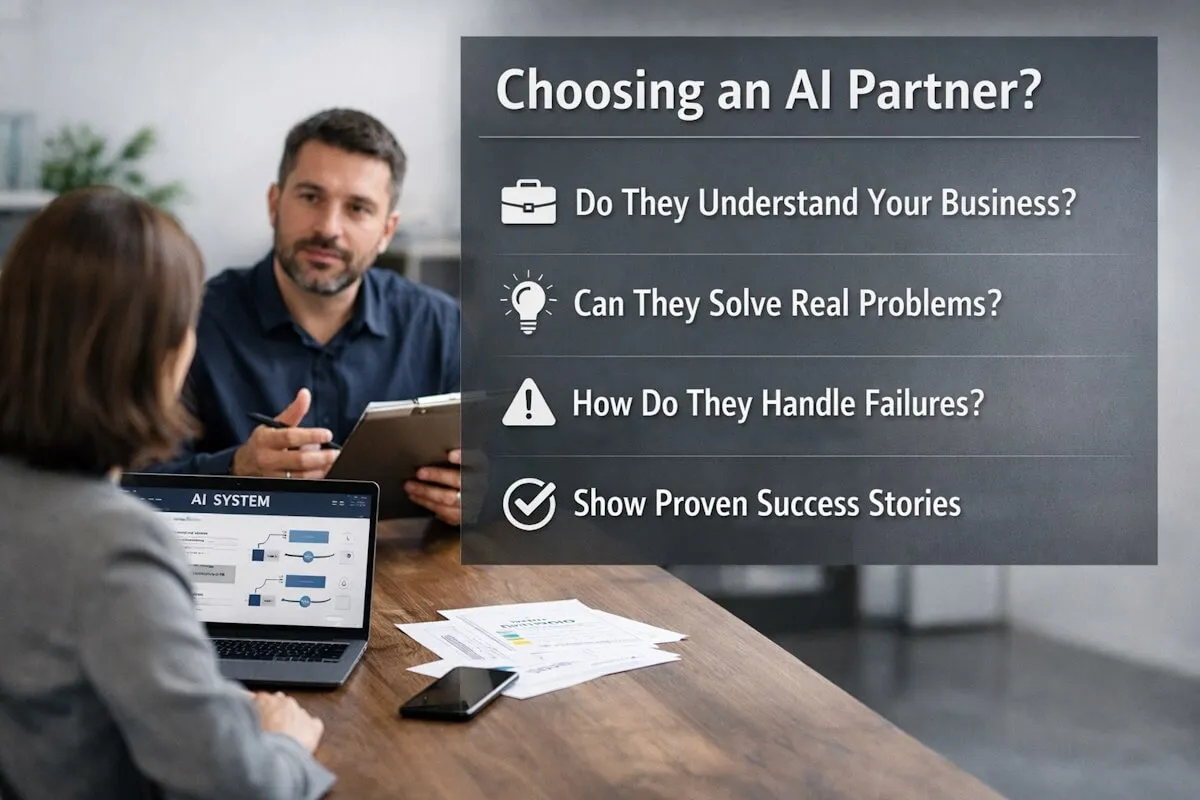
Hiring the wrong partner for your AI project can slow you down more than doing nothing at all.
That might sound harsh, but it’s true.
Agentic AI is not just another tech upgrade. It directly affects how your business runs. If the system fails, your operations feel it immediately.
So before you sign any contract or start a project, you need clarity.
Not just on what you want to build, but on who you’re trusting to build it.
Let’s walk through what actually matters.
Start with how they understand your business
A good partner won’t jump straight into solutions.
They’ll ask questions. A lot of them.
About your workflows. Your bottlenecks. Your current tools. Your team structure.
Why does this matter?
Because agentic systems are built around goals, not just features.
If your partner doesn’t understand how your business operates, they won’t design systems that fit into it.
And that’s where things start to break.
Look beyond technical skills
It’s easy to get impressed by technical talk.
Frameworks, models, architectures. Sounds great in meetings.
But that’s not what defines a good agentic AI partner.
What really matters is how they:
- Break down complex processes
- Design decision flows
- Handle real-world scenarios
- Plan for unexpected situations
You’re not just hiring developers. You’re hiring problem-solvers.
Ask how they design execution flows
This is a big one.
Agentic AI is all about execution.
So you need to understand how your partner approaches it.
Ask them:
- How do you define system goals?
- How do you decide the sequence of actions?
- What happens when something fails?
If they can’t explain this clearly, that’s a red flag.
Because unclear execution design leads to unreliable systems.
Check how they handle edge cases
Real-world systems are messy.
Things don’t always go as planned.
Inputs can be incomplete. Data can be wrong. External systems can fail.
A strong partner plans for this.
They build:
- Fallback mechanisms
- Error handling flows
- Escalation paths
If they only focus on ideal scenarios, you’ll run into problems later.
Evaluate their approach to control and oversight
Here’s something important.
You don’t want a system that runs completely unchecked.
And you don’t want one that needs constant supervision either.
There’s a balance.
Ask your partner:
- How can you monitor system actions?
- Where can humans step in if needed?
- How do you adjust behavior over time?
Good partners design systems that give you control without slowing things down.
Understand how they connect systems
Agentic AI doesn’t work in isolation.
It needs to interact with your existing tools.
CRMs, databases, communication platforms, internal dashboards.
So your partner should be comfortable working across systems.
More importantly, they should ensure:
- Data flows smoothly
- Actions trigger correctly
- Dependencies don’t cause failures
This part often gets underestimated, but it’s critical.
Don’t ignore communication style
You’ll be working closely with this team.
If communication is unclear or overly technical, things get frustrating fast.
A good partner:
- Explains things in simple terms
- Keeps you updated regularly
- Sets realistic expectations
- Listens to your concerns
You shouldn’t feel lost during your own project.
Ask for practical examples, not just promises
Anyone can say they build smart systems.
What you need is proof.
Ask for:
- Examples of similar workflows they’ve built
- How those systems behave in real scenarios
- What challenges they faced and how they handled them
You’re not looking for perfection.
You’re looking for experience.
Make sure they don’t overpromise
If something sounds too easy, it probably isn’t.
Agentic AI projects require planning, testing, and refinement.
Be cautious of partners who:
- Promise instant results
- Skip discussions about challenges
- Avoid talking about limitations
A reliable partner will be honest about what’s possible and what takes time.
Why choosing the right partner matters more than ever
Agentic systems sit at the core of your execution.
They handle tasks that directly impact your business.
If they’re built well, things run smoothly.
If not, you deal with:
- Delays
- Errors
- Frustrated teams
- Poor customer experience
That’s why many businesses turn to specialized Agentic AI Development Services instead of experimenting on their own.
It reduces risk and gives you a stronger starting point.
What happens when you rush this decision
Let’s be real.
Choosing a partner quickly, without proper evaluation, can cost you more later.
You might end up:
- Rebuilding systems
- Fixing poor workflows
- Dealing with inconsistent performance
And that slows everything down.
Taking a bit more time upfront saves you from bigger issues later.
Should you hire internally or work with a partner?
This depends on your situation.
If you already have a strong team, you might consider building in-house.
But if you’re just starting, working with experts is often the better move.
When you Hire AI Agent Developers, you get access to:
- Experience across different use cases
- Proven approaches to system design
- Faster setup and execution
You can always build your internal team later.
A simple checklist before you decide
Here’s a quick way to evaluate any partner.
Ask yourself:
- Do they understand my business clearly?
- Can they explain their approach in simple terms?
- Have they handled real-world scenarios before?
- Do they plan for failures and edge cases?
- Will I have visibility and control over the system?
If the answer is yes to most of these, you’re on the right track.
What your next step should look like
Don’t rush into development.
Start with conversations.
Talk to a few partners. Compare how they think, not just what they offer.
Pay attention to:
- How they ask questions
- How they explain solutions
- How they handle uncertainty
That will tell you more than any proposal document.
The bigger picture
Agentic AI is changing how businesses execute work.
And your partner plays a huge role in how successful that shift will be.
This is not just a technical decision.
It’s a business decision.
So, who are you trusting with your systems?
At the end of the day, it comes down to this.
Are you choosing a partner who just builds what you ask for?
Or one who understands what you actually need and builds systems that work in the real world?
Because that difference will shape how your business operates moving forward.